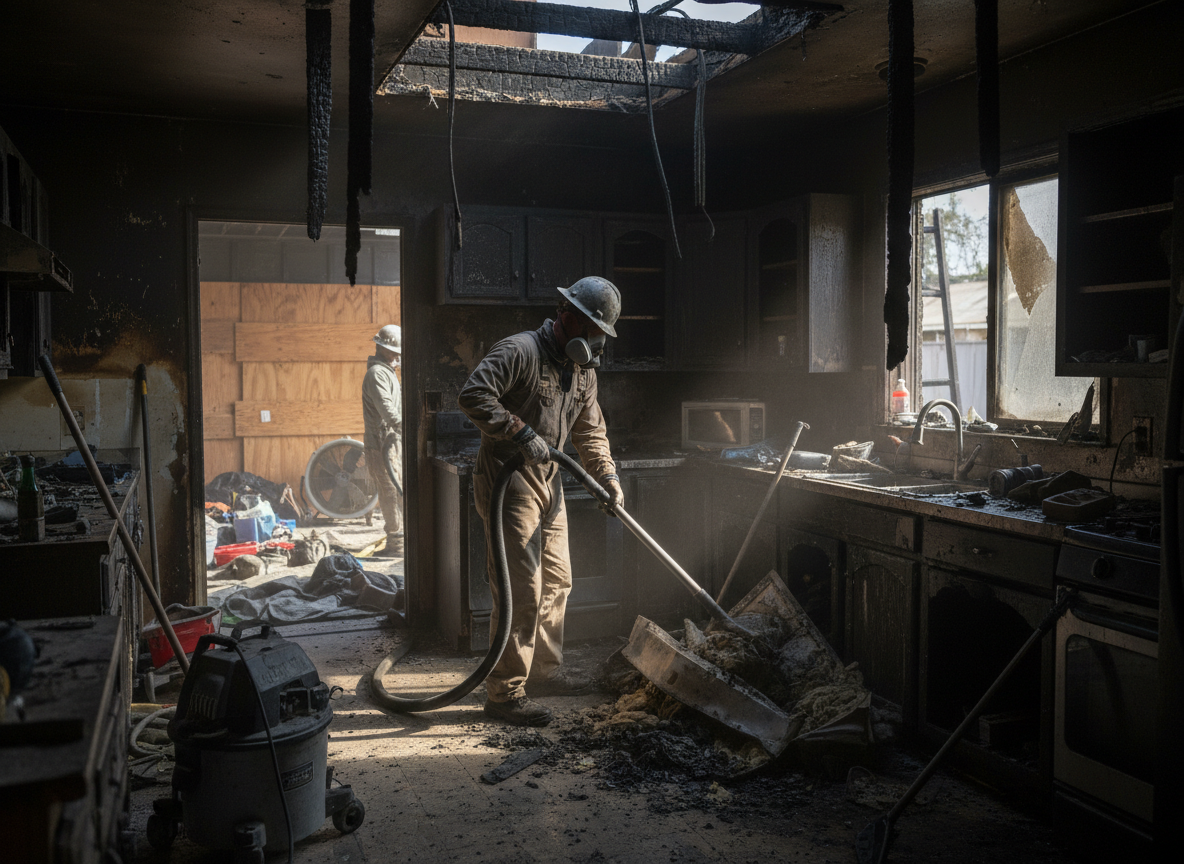
Mentone sits in San Bernardino County with a mild Mediterranean climate that brings hot, dry summers and cool winters. Those dry summers increase the chance of ember intrusion through vents and under eaves, especially in single-story ranch homes built from the 1950s through 1970s that line streets near Zanja Creek. When fire occurs, soot travels quickly through the open floor plans common in these houses and settles inside wall cavities and HVAC returns.
Redlands, Yucaipa and Calimesa share the same wind patterns, so crews often see smoke migration across property lines. Older wood-frame construction with original plaster or drywall means hidden charring behind baseboards and in attic insulation. Water used during suppression can pool against slab foundations, raising the risk of secondary mold if extraction is delayed beyond the first 48 hours.
Emergency protocols start with air monitoring for particulates and carbon monoxide before any entry. Crews then establish negative pressure to prevent cross-contamination into unaffected rooms. In Mentone homes, this often requires sealing off the carport or attached garage first because those spaces share ductwork with living areas.
Final clearance testing checks for residual odors and surface pH after deodorization and HEPA filtration. Homeowners in the area frequently discover that contents stored in garages or sheds near Mentone Park need separate treatment because wind-driven smoke travels farther than the flames.
Technician insight
In Mentone, the thing that catches most people out with Emergency fire damage restoration is how the dry summer winds push fine soot under stucco weep holes and into the crawl spaces of 1960s homes near Zanja Creek. Homeowners often focus on visible rooms and miss the odor that returns weeks later when the cool winter air pulls that residue back into living spaces.
Creek-adjacent home after kitchen fire
A Mentone residence near Zanja Creek suffered a kitchen fire that sent smoke through the central HVAC. Inspection showed soot inside the ductwork and light charring on ceiling joists. Crews sealed the system, removed affected drywall and insulation, then ran negative air while drying water used by firefighters. The home passed clearance testing within five days and was returned to the owners without recurring odors.
How it works
- 1
Secure And Assess
Board up openings, set up containment, and perform moisture and air-quality readings inside the structure.
- 2
Remove Contaminated Materials
Extract charred drywall, insulation and carpet while protecting unaffected zones from soot redistribution.
- 3
Clean And Deodorize
Apply HEPA vacuuming, chemical sponges and thermal fogging to surfaces and HVAC systems.
- 4
Dry And Monitor
Use air movers and dehumidifiers on water-affected areas, then retest until readings meet industry standards.
- 5
Final Clearance
Conduct visual and odor inspection with the homeowner before releasing the property.
Pricing
Upfront quotes issued after on-site inspection; cost driven by square footage affected and whether HVAC or structural members require replacement.